Travel
Pawliday
strategic design
product design
user research
Overview
A one‑stop booking and concierge concept that turns today’s stressful, manual planning with pets into a guided, trustworthy experience for travelers and genuinely pet‑friendly businesses.
Tools
Figma, Pen & Paper, FigJam, Adobe Creative Suite, Miro, ChatGPT, Gemini
Duration
2,5-day design sprint
Outcomes at a glance
Chose pet owners as my “community bet” and showed they’re not a niche, but a high‑spend, emotionally invested segment with serious travel friction.
Reframed the problem from “find more pet‑friendly options” to “I don’t trust what the label promises,” putting broken expectations at the center.
Evolved a simple B2C idea into a B2C+B2B ecosystem that rewards businesses for being truly pet‑friendly instead of just marketing it.
Delivered a paper prototype of a Travel Itinerary Concierge, a first Business Model Canvas, and a concrete testing roadmap within 2.5 days.
Challenge
Lufthansa Innovation Hub asked for a venture idea for an underserved travel community that could still move the business needle.
I saw pet owners who treat their pets like family, yet are forced into stressful, manual planning with unreliable filters, hidden fees, and constant doubt: “Can I really bring my dog, or will this blow up at check‑in?”.
Objective
In just 2.5 days, find a community where values and emotions genuinely shape demand, frame a problem that matters both to travelers and the business, and turn it into a venture‑scale concept with a clear path to validation.

Solution
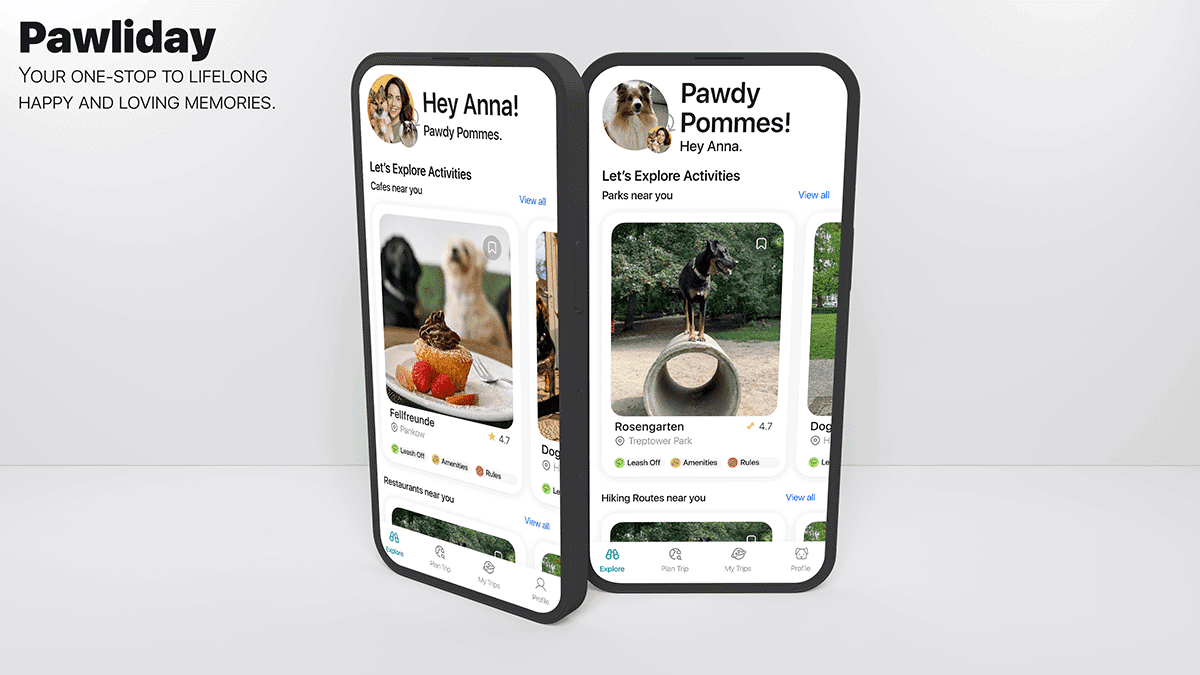
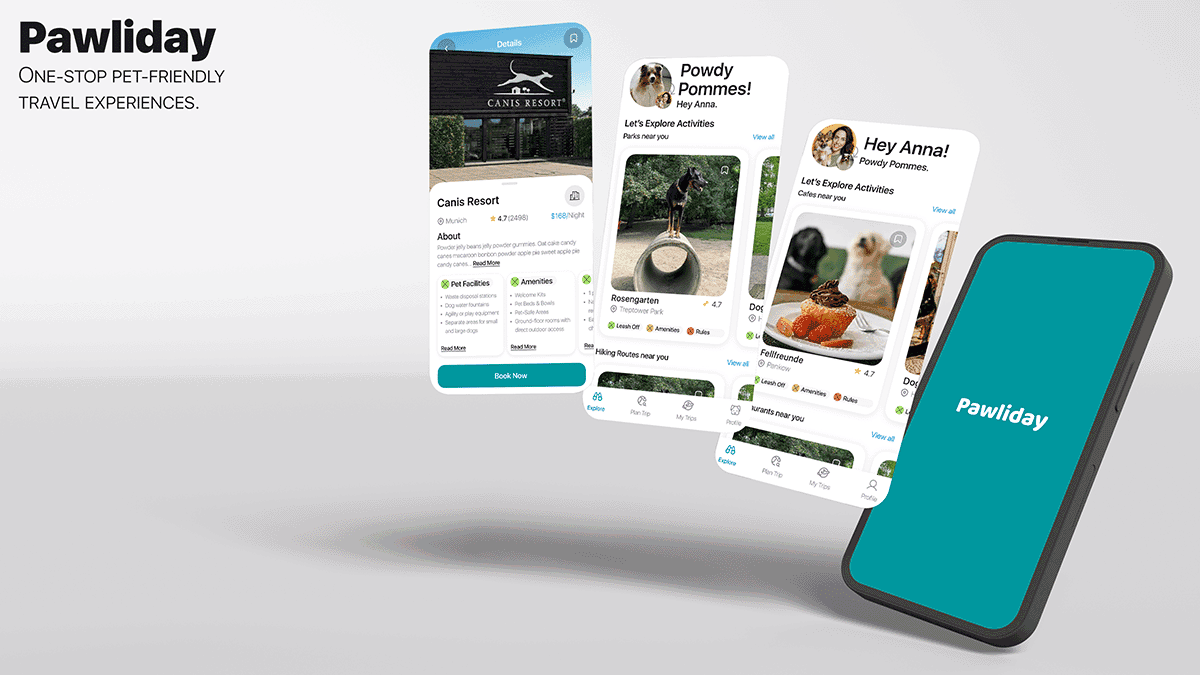
Pawliday is my proposal for a pet‑friendly travel platform that behaves more like a trusted concierge than a search engine.
For travelers, a guided Travel Itinerary Concierge simplifies decisions across transport, accommodation, and activities.
For businesses, certification, visibility, and analytics make it worthwhile to become genuinely pet‑friendly instead of ticking a box.
Outcomes & impact
Showed that pet owners are a strategic community, not a cute side story: high ownership rates, strong spend, and a projected 430bn pet market signal real venture potential.
Built a Travel Itinerary Concierge prototype that walks pet owners through a trip in a few steps, surfacing pet policies at the right moments instead of as fine print.
Exposed trust and transparency as the real problem: people don’t just need “more options,” they need to know what “pet‑friendly” actually means before they click book.
Created a first Business Model Canvas and a test plan across desirability, viability, and feasibility, so the concept could be stress‑tested rather than admired.
Turned a B2C product idea into a trust ecosystem: travelers get clarity and guidance, businesses get certification, visibility, and feedback loops that reward good behavior.
Stakeholders at Lufthansa Innovation Hub described Pawliday as a clear, opportunity‑backed direction they could imagine pushing forward—not just a polished sprint artifact.
Broader transfer
This project sharpened a pattern I now like to reuse:
Find the emotional “edge cases” where people currently opt out, then design ecosystems that realign incentives instead of just adding features.

Empathize
Choosing where to place a bet
Purpose
Turn a wide‑open brief about “underserved communities” into a concrete decision.
Whose travel experience needs to change, and why is this a smart bet?
Approach
Looked at different communities, e.g. families, people with disabilities, and pet owners, through two lenses: human relevance and feasibility in a 2.5‑day sprint.
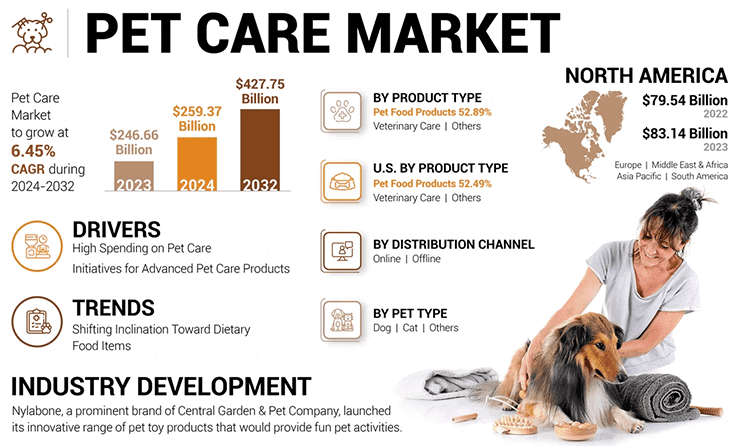
Used desk research to sanity‑check my intuition that pet travel is more than a niche: ownership, spending, and market projections.
Since I don’t own pets and am allergic, I deliberately sought out a pet owner to talk through her last trips with her dog: from search queries to “Oh no, I missed that restriction.”
Key insights
Pet owner market
66–70% of households own pets
97% consider pets family
global market projected at ~$430bn by 2032
strong willingness to pay for convenience and trust
Travel vs. Pets, a Dilemma
Pet owners are everywhere and deeply attached to their animals. Travel is emotionally loaded because leaving the pet behind feels like a betrayal, but taking them along feels risky.
Planning is a grind
Fragmented sites, unreliable “pet‑friendly” filters, surprise cleaning fees, and anxiety around regulations, especially when crossing borders.
Uncertainty Is Cancelling Trips
Some people simply stop travelling rather than gamble with bad information, which is a strong signal that the current ecosystem is failing both them and the industry.
Define
Naming what is really broken
Purpose
Resist the easy answer (“better filter feature”) and instead name the core problem in a way that could guide both UX and business decisions.
Approach
Captured the interview and research in an empathy map and personas for “Anna” and her dog “Pommes,” focusing on fears, workarounds, and emotional spikes.
Structured the problem with 5Ws to separate symptoms (too many tabs, time lost) from underlying causes (unclear, inconsistent rules).
Used a Value Proposition Canvas to link pains and gains to possible solutions and iterated the wording of the problem statement until it felt sharp and honest.
Empathy Map
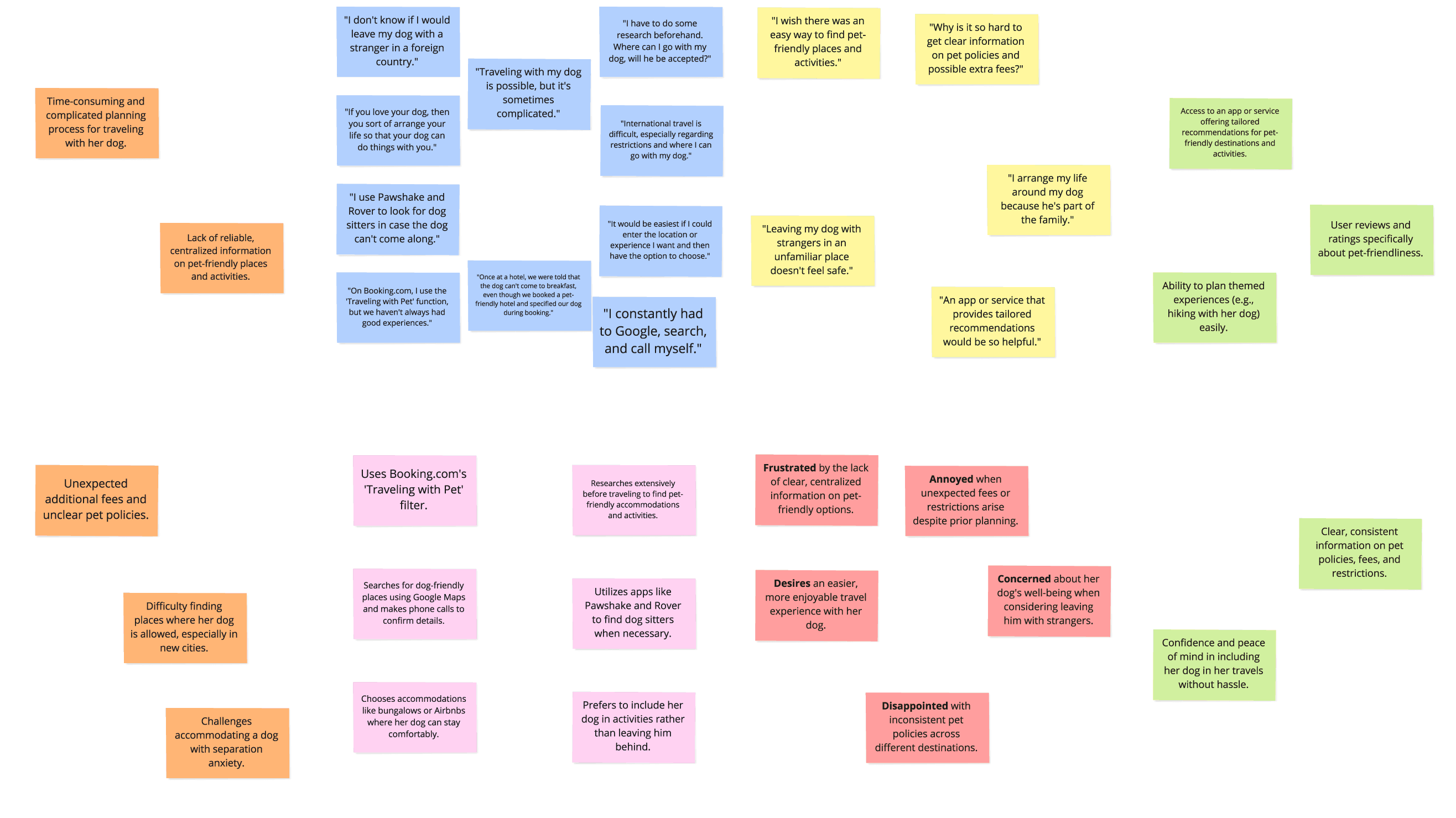
Persona

Pommes, making the emotional stakes of travel concrete. Anna’s decisions are always filtered through his safety and comfort.

Value Proposition
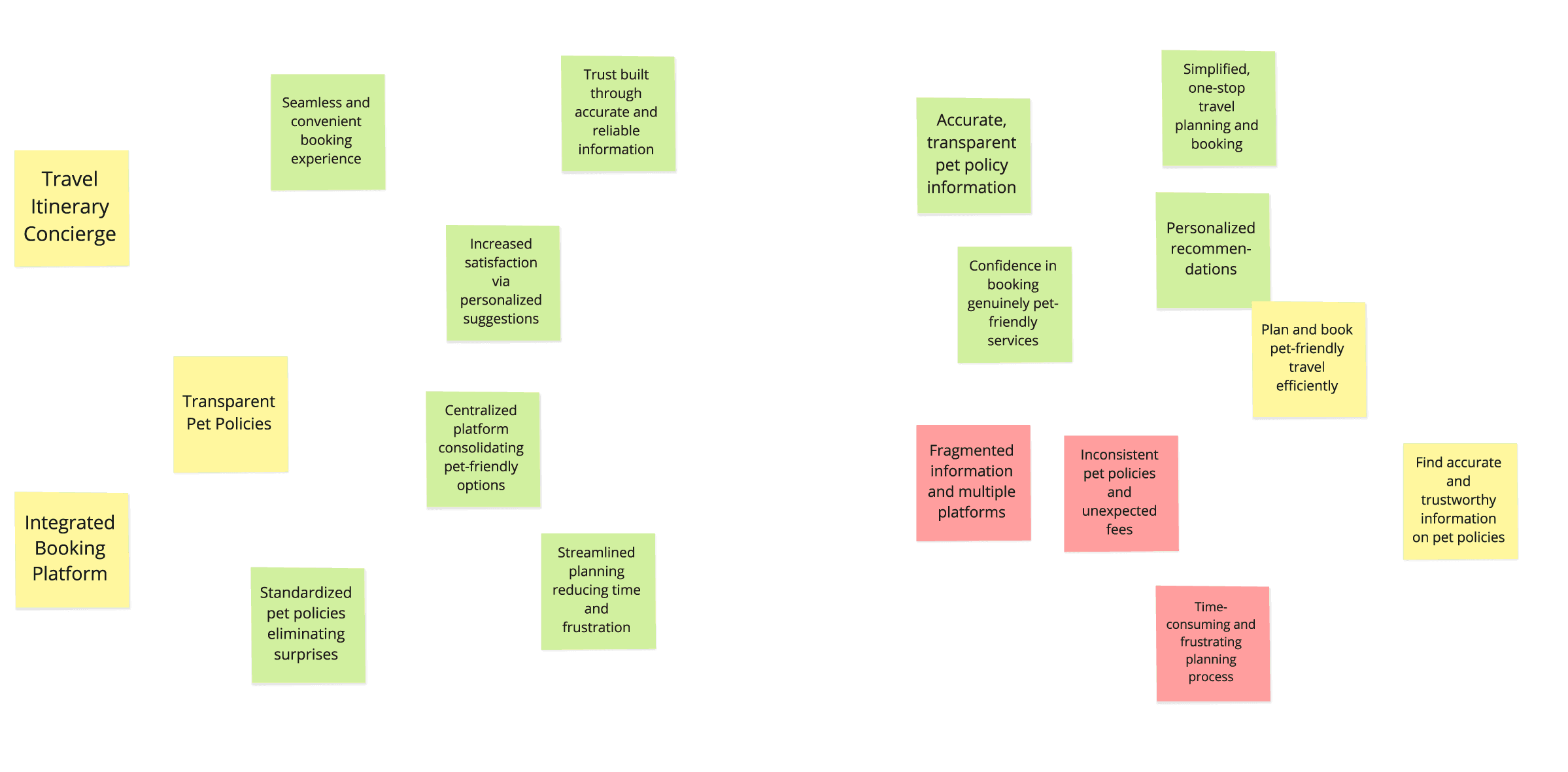
Key insights
A breach of trust
The painful moment is not “I can’t find anything” but “I thought this was fine, and now it isn’t”.
Reframing
Defining the core problem pushed me to think in terms of standards and guarantees, not just discovery features.
Problem Statement
Pet owners who consider their pets as family members need a unified, reliable platform to find and book genuinely pet-friendly transportation, accommodations, and activities, because current solutions fragment information, obscure policies, and create frustration through unexpected restrictions and fees.
Ideate
From experience to ecosystem
Purpose
Design something that doesn’t just feel nicer, but structurally changes how pet‑friendly travel works for both sides.
Approach
Turned research into HMWs and user stories anchoring my ideation.
Explored feature ideas: Travel Itinerary Concierge, personalized recommendations, transparent policies, feedback loops, Adventure Mode, and end-to-end booking.
Outlined features: a travel itinerary concierge, personalized recommendations, standardized policy views, feedback incentives, “Adventure Mode,” and a more end‑to‑end booking flow.
Mid‑sprint, I stepped back and asked a hard question: “Why would businesses care?” That led to a B2B layer: certification, extra visibility, analytics, a small‑business marketplace, and ad partnerships.
How Might We Questions
How might we create a unified, intuitive platform that allows pet owners to find, book, and manage pet-friendly transportation, accommodations, and activities all in one place?
How might we streamline the travel planning process for pet owners to reduce time and frustration associated with using multiple platforms?
How might we personalize recommendations for pet-friendly destinations and activities based on the preferences of both the pet and the owner?
How might we leverage technology to offer innovative features that simplify traveling with pets, such as AI-driven suggestions or real-time updates on pet policies?
How might we ensure consistency and transparency in presenting pet policies and fees across different service providers to eliminate confusion and build user confidence?
How might we collaborate with businesses to improve and promote genuinely pet-friendly services, making it easier for pet owners to identify them?
User Stories
As a pet owner, I want to plan my entire trip with my pet in a few simple steps so that I save time and avoid frustration.
As a pet owner, I want to see clear and standardized pet policy information for each service provider so that I understand what to expect.
As a pet owner, I want to discover pet-friendly activities at my destination so that my pet can be part of the experience.
As a pet owner, I want to see verified pet-friendly labels on accommodations and services that meet certain standards so that I can trust their pet-friendliness.
Possible Features
Travel Itinerary Concierge
A wizard-app for planning personalized, pet-friendly travel experience and booking via API or affiliate links.
Personalized Recommendations
User profiles, pet details, and preferences to suggest tailored itineraries and activities.
Transparent Pet Policies
Clear, standardized pet policies and fees for each listing to eliminate surprises.
Feedback Incentivization
Rewards system for users providing feedback, such as loyalty points, discounts, or badges.
Adventure Mode
User can explore their vicinity with a guided map navigation to verified pet-friendly activities.
End-to-End
Direct bookings of pet-friendly travel experiences, redirects to third-party for bookings.
Reframing
From User Value to Ecosystem
Early ideation focused heavily on user value. During the process, it became clear that:
A strong B2C proposition alone might not be sufficient
without clear incentives for needed B2B partners.
Added Features
Business Certification Program
Standardized and transparent audit process for businesses to get pet-friendly certified.
Promotion for Certified Partners
Partner businesses within the platform are giving a greater visibility to the target market.
Business Analytics Dashboard
Dashboard to access user feedback and analytics to help them improve services and to advance to partner levels ot improve to premium status.
Advertising Partnerships
Collaborate with insurances, big vendors for grooming, hygiene, toys to offer promotions on their product/services.
Small Business Market Place
Small business can access a market place offering B2B or B2E services like walking service, pet-sitting, food delivery, grooming.
Results
First touchpoint
The concierge feature surfaced as the right first touchpoint. It lets users feel the benefit of clarity and guidance immediately.
Ecosystem emerges
The B2B layer created aligned incentives. Businesses gain visibility and insight when they commit to clear, trustworthy pet policies
Novel proposal
The concept matured from “better pet-friendly search” into Pawliday as trust infrastructure for pet travel, strengthening the venture case.
Prototype
Travel Concierge as a learning engine through testing
Purpose
Build just enough to learn whether a guided experience can actually reduce stress and confusion for pet owners.
Approach
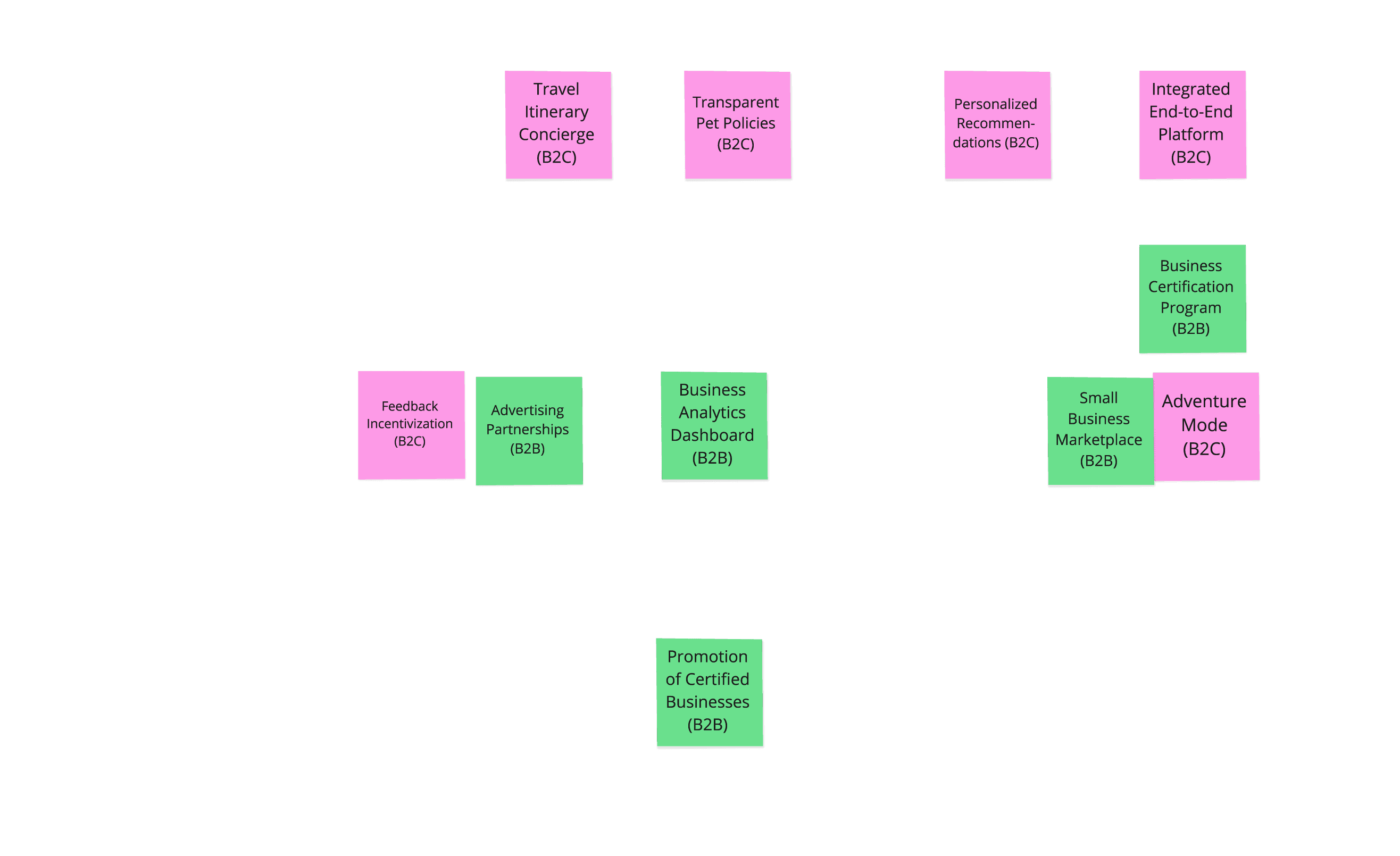
Used an impact/effort matrix to prioritize which features to prototype under sprint constraints, selecting the concierge flow, transparent pet policies, and visibility for certified businesses.
Designed a mobile‑first paper prototype of a wizard‑style Travel Itinerary Concierge: trip kick‑off, destination and dates, transport and accommodation choices, curated itinerary, clear policy views, and booking confirmation.
Defined a testing plan: qualitative interviews and post‑task surveys on trust and effort; quantitative indicators such as satisfaction, task success, and time to complete.
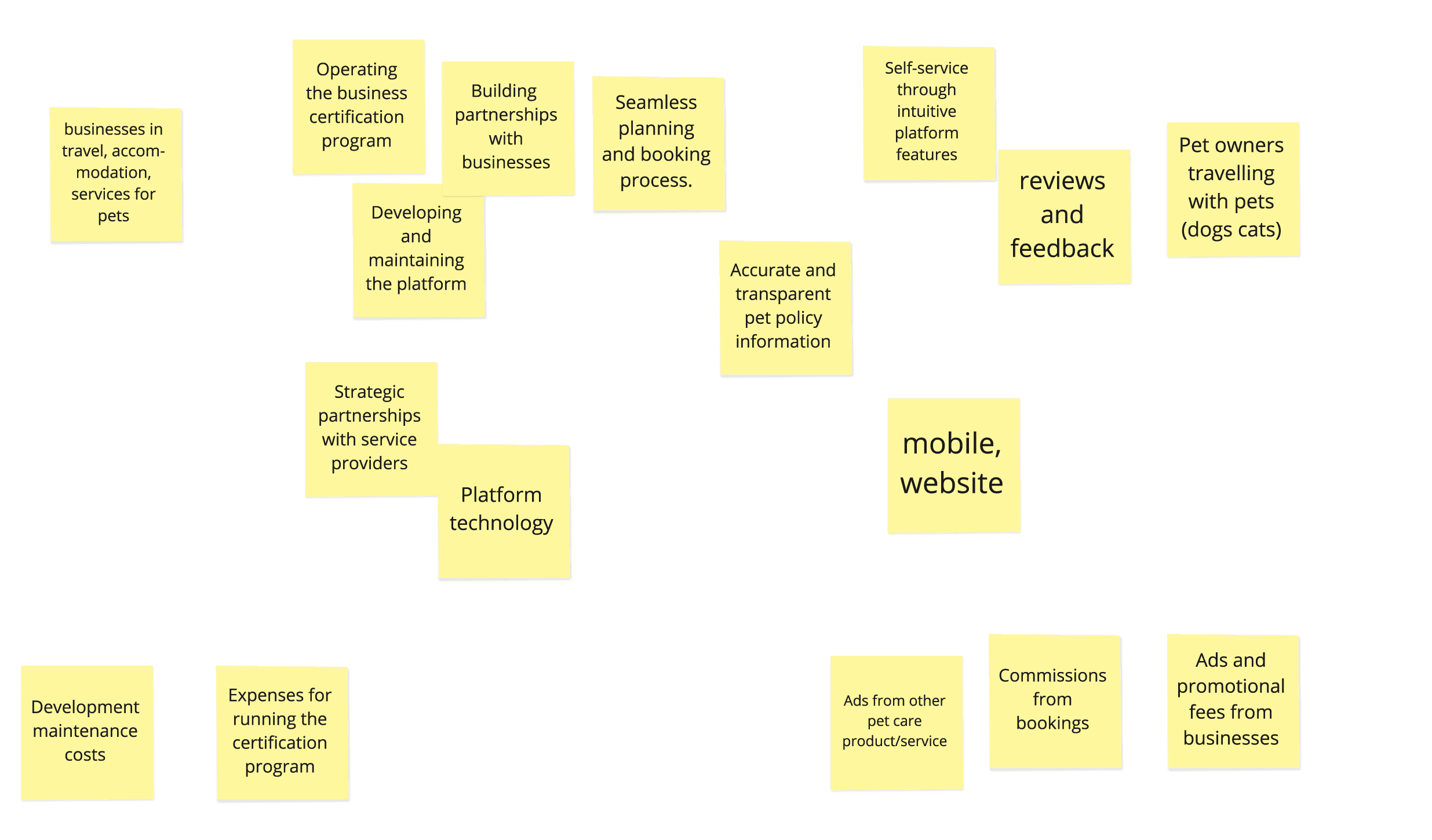
Created an initial Business Model Canvas and a desirability/viability/feasibility impulse list as a workshop artifact rather than a finished answer.
Impact & Effort
Rapid Prototyping
User Story - Travel Itinerary Concierge
As a pet owner, I want to plan my entire trip with my pet in a few simple steps so that I save time and avoid frustration.
Entry & Trip Kick-off
The Travel Itinerary Concierge introduces users to a guided, wizard-style flow for planning a personalized, pet-friendly trip.
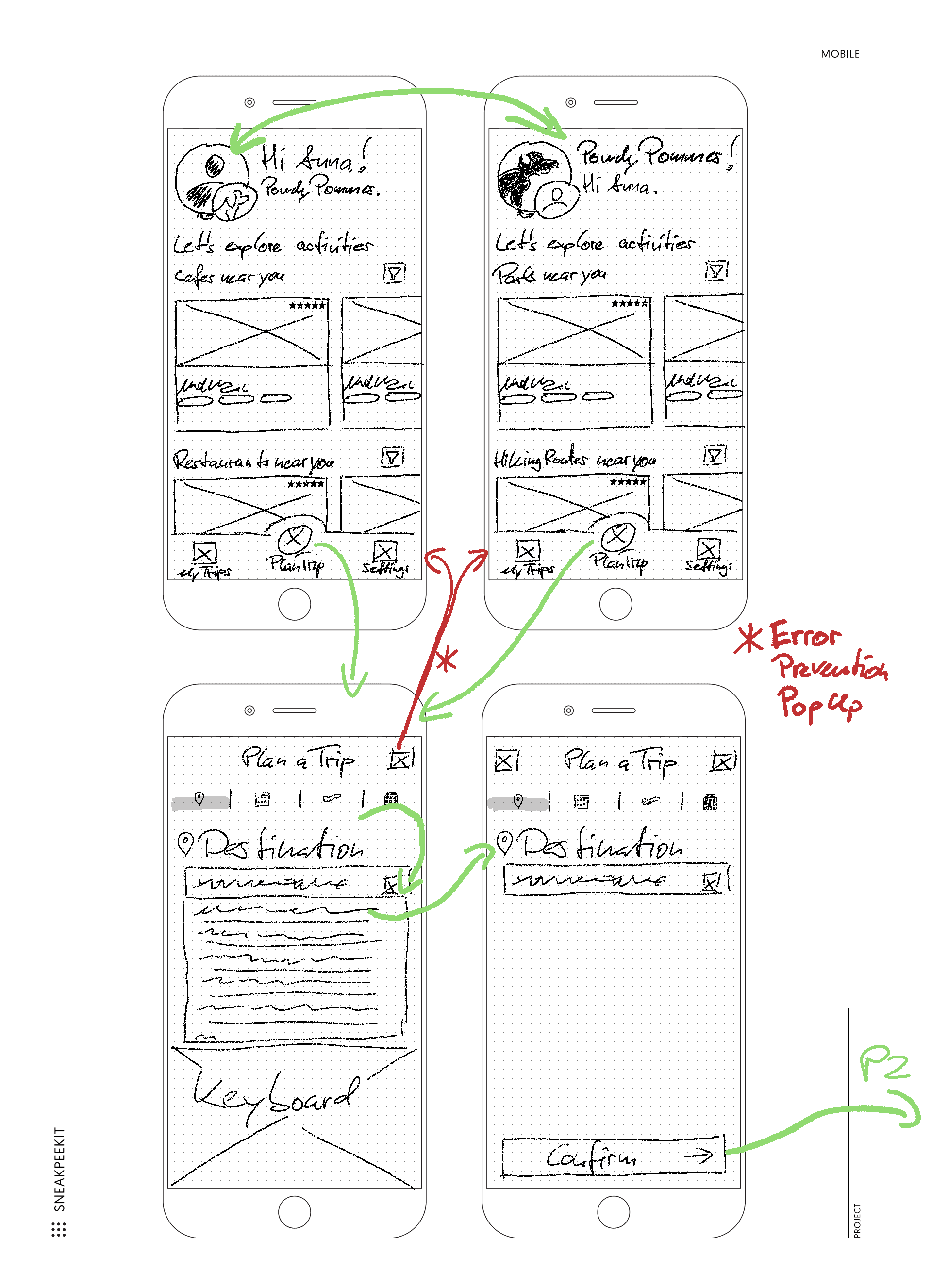
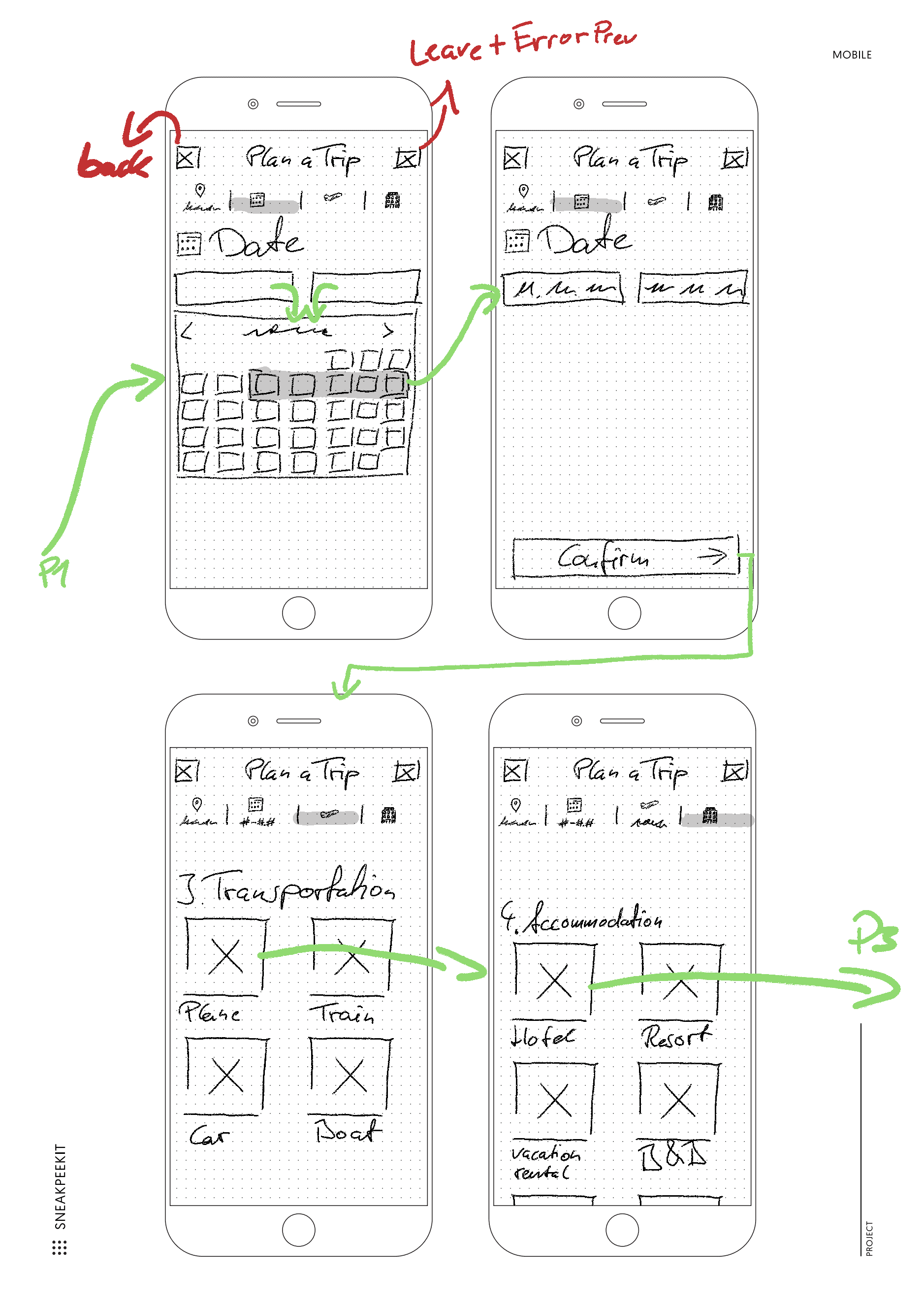
Guided Trip Definition
Users define destination and dates through a structured, step-by-step aiming at reducing cognitive load.
Curated Itinerary Assembly
The concierge progressively curates transportation, accommodation, and activity options, enabling users to review, adjust, and confirm choices within the same guided flow.
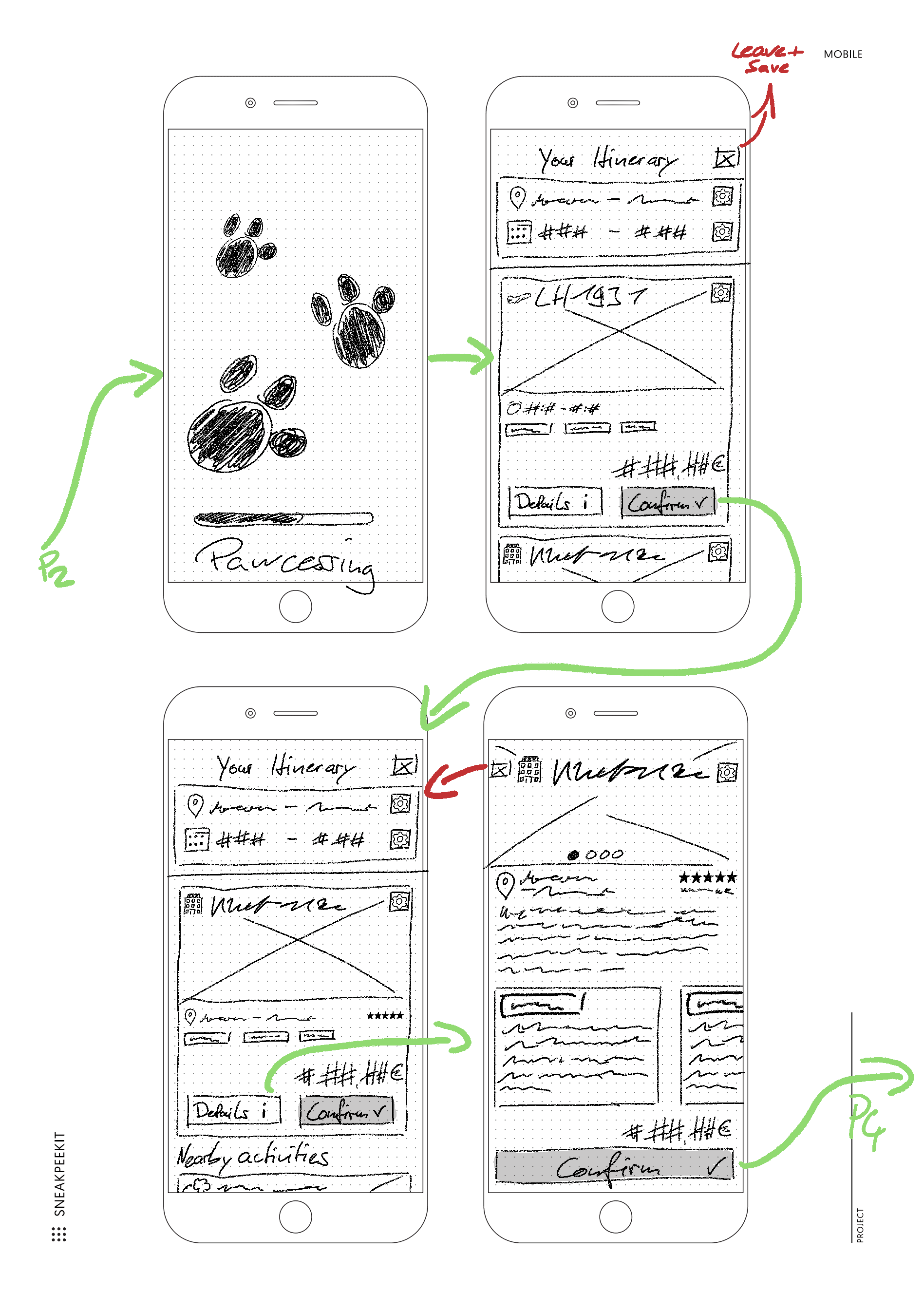
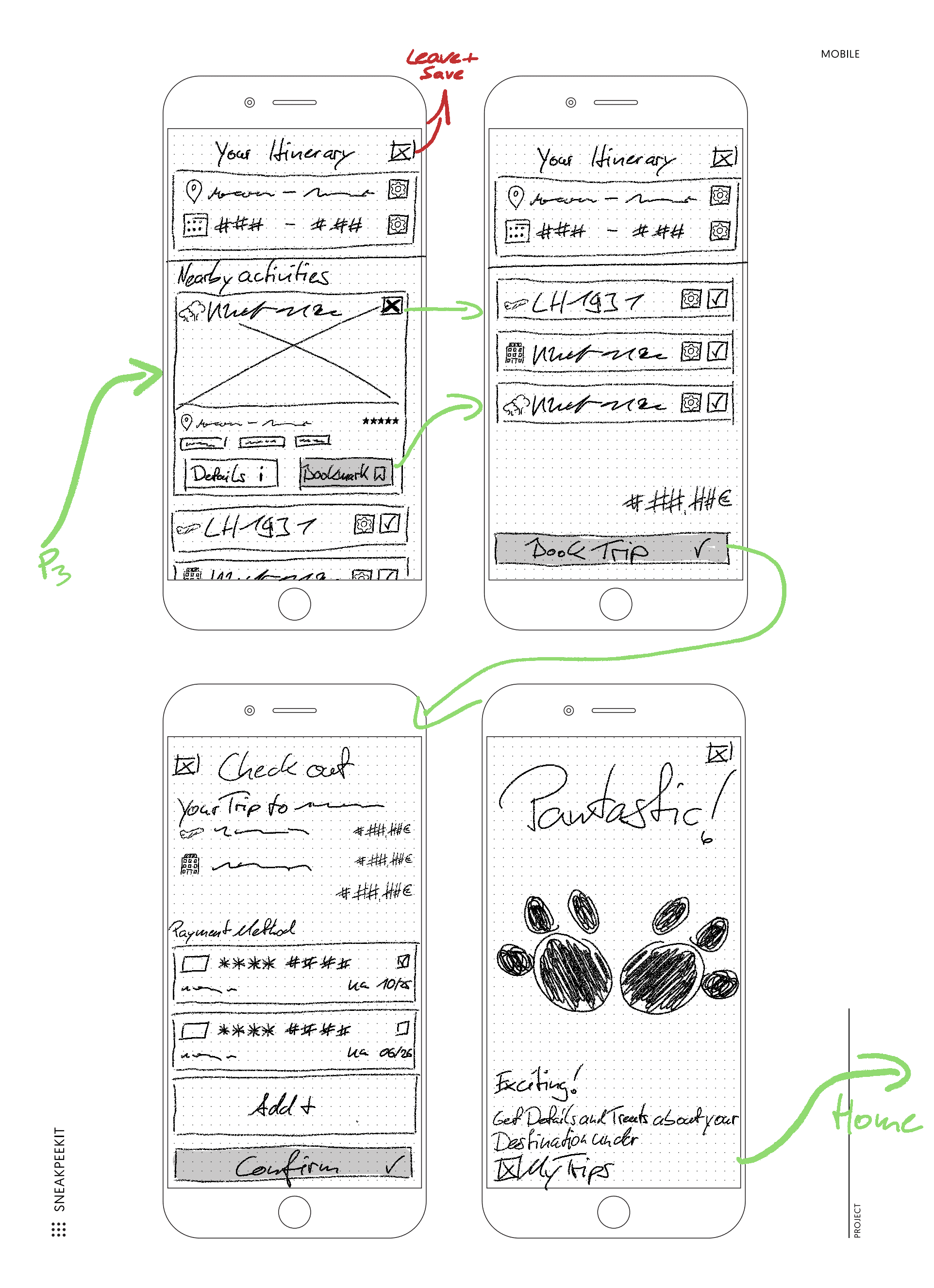
Booking & Completion
The concierge concludes with a consolidated itinerary review and check out process, followed by a clear confirmation and return to the home screen.
Business Model Canvas
Test and Next Steps
Due to the limited time frame of the 2.5-day design sprint, it was not possible to conduct usability testing within the scope of this project.
However, the sprint outlined a clearly defined testing roadmap for the Travel Itinerary Concierge prototype. This could be done early and rapidly with the paper prototype or one with a higher fidelity.
Planned Evaluation
Post-Task Survey and Interviews
This will serve as the most critical component, generating qualitative insight into user perceptions, trust, and friction points, and informing how the solution can be refined to better align with real user needs.
Quantitative Metrics
Satisfaction Rating, Task Success Rate, Time to Complete Task could assess whether the concierge flow reduces frustration, enables independent planning, and lowers effort and time.
From Prototype to Product Thinking
In parallel to the experience design, I created an initial Business Model Canvas as a discussion and workshop artifact.
Rather than presenting it as a finished model, it was intended as a starting point to collaboratively refine and stress-test the venture idea with stakeholders.
Desirability
Gain deeper understanding through surveys and additional interviews with pet owners
Improve and test the first iteration of the Travel Itinerary Concierge prototype
Viability
Probe the market to define competitive commission fees
Develop certification criteria and audit processes for pet-friendly businesses
Feasibility
Explore recommendation algorithms and data privacy considerations
Investigate lightweight technical solutions for end-to-end booking (direct bookings vs. affiliates)
Next Steps
Based on the sprint outcomes, the following next steps were identified:
Validate desirability with a broader group of pet owners
Test and iterate the concierge flow through lightweight usability testing
Refine certification criteria together with partner businesses
Explore a phased rollout, starting with a focused travel vertical
Learnings & Reflection
Constraints as a forcing function
Two and a half days meant I had to commit early: to pet owners, to a concierge rather than a full platform. This made the story sharper but also exposed every trade‑off.
Follow friction, not features
Listening to guilt, mistrust, and avoidance behaviors revealed that broken expectations and hidden rules, not “missing features”, define the real problem.
Meaningful ecosystem
Calling something “pet‑friendly” only works if everyone shares the same meaning and has a reason to uphold it. That’s why the B2C+B2B pivot matters to me.
Structured speed
Using a proven Design Thinking arc allowed me to move fast without worrying about process, and spend my energy on meaning, bets, and trade‑offs.
Iteration as honesty
Revisiting assumptions mid‑sprint and expanding into an ecosystem was not indecision but critical reflection on viability and scalability.
What I carry forward
Since Pawliday, I look for emotionally loaded moments, and then ask: what would it take, semantically and structurally, for people to feel safe saying yes again?
More works


Let’s talk.

Prefer a quick conversation? We can align on expectations, product context, and whether there is a good fit.
15 minutes