
Loyalty & Rewards
product strategy
system design
ux-design
Overview
Transforming cashback from a delayed, opaque utility into a clear, motivating savings ecosystem built around instant value, personal relevance, and a unified dashboard.
Tools
Figma, Pen & Paper, FigJam, Miro, Google Analytics, Hotjar, Google Forms, ChatGPT, Gemini
Duration
~6 months
Outcomes at a glance
Reframed "cashback as a one-off transaction" into an integrated savings ecosystem with clear roles for loyalty, personalisation, and monetisation.
Defined a unified dashboard and value architecture that reduces fragmentation and makes "all my value" visible at a glance.
Evolved an isolated loyalty-points idea into a system of experience points, boosts, missions, and exchanges that reinforce each other instead of adding noise.
Delivered a token-based design system and phased roadmap so the team can implement smartCashback incrementally without a risky big-bang relaunch.
Supported the team in evolving the brief from “add a loyalty-points feature” toward a long-term loyalty ecosystem, using user behaviour and operational constraints as shared reference points.
Challenge
The existing cashback platform performs well from a business perspective, but the experience faces typical challenges of affiliate based cashback systems, including delayed confirmation and fragmented value perception.
Users wait days or weeks for confirmation, struggle to translate percentage rates into real money, and rely on search because relevant offers are buried in generic layouts.
Internally, the brief was to "add loyalty points" to fix retention, but simply adding points on top of the existing journey risked increasing complexity without necessarily strengthening the experience.
Solution
Through research and cross-functional workshops, the brief was reframed into smartCashback: a unified savings ecosystem.
At its core are experience points (EP) as instant rewards, Cashback-Mission as a personal savings goal, cashback boosts and Direct Cashback to introduce immediacy, personalised recommendations and a smart search to surface relevant value early, all orchestrated in a single, unified dashboard that can scale over time.
A direction the team agreed would better serve retention and engagement.
Outcomes & impact
Clarified the core problem: cashback mechanics were fine, but the experience layer (timing, relevance, feedback) was the real blocker to motivation and loyalty.
Defined a product vision: "Transform cashback from a delayed utility into a personalised, loyalty-driven savings ecosystem," which became the north star for future product decisions.
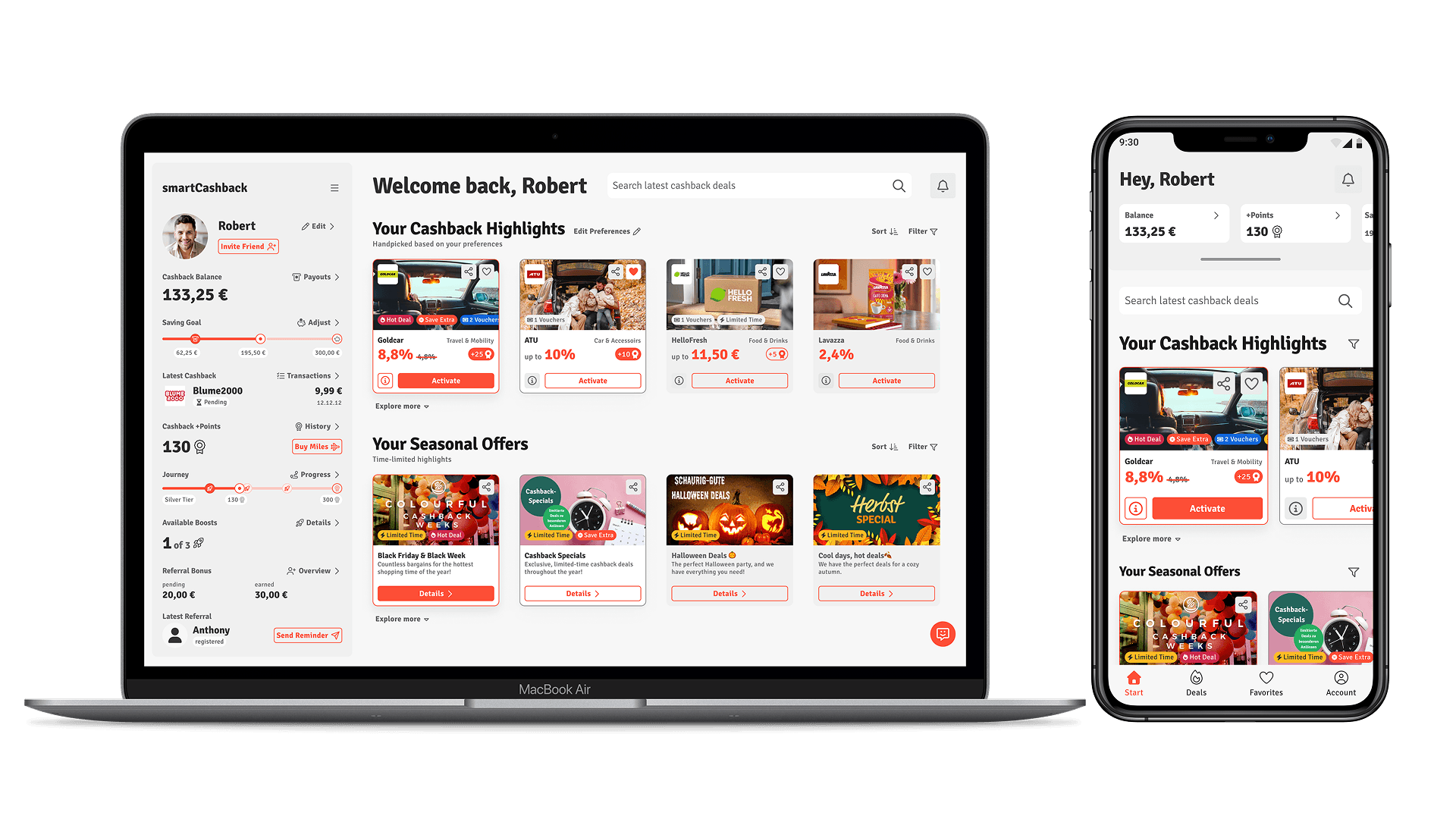
Designed a unified dashboard that brings cashback, experience points (EP), missions, recommendations, and tools into a single, scannable view, reducing the need to jump across multiple disconnected pages.
Created a cohesive reward system: EP for instant feedback, boosts for meaningful peaks of value, Direct Cashback for immediacy, and exchanges for partner rewards beyond cashback.
Established a token-driven design system and modular feature blocks, enabling consistent behaviour across web and app and lowering the cost of future extensions.
Delivered a phased roadmap that balances ambition with operational and technical reality.
Broader transfer
This project strengthened a reusable pattern: A single feature cannot improve a long value chain. Analysing the whole journey’s timing, feedback, and semantics allows redesigning for improved value.
I now explicitly treat roadmaps and system design as one artefact: you don't just design screens. You design how the organisation can safely focus onto a growth ecosystem and navigate its maturation.

Discover
Why cashback didn’t feel rewarding enough
Purpose
Turn a vague “add loyalty” ambition into a grounded understanding of how people actually use the cashback platform, where motivation drops, and which parts of the journey are structurally hard to change.
Approach
Analysed Google Analytics funnels to understand typical session paths and where users drop off.
Reviewed Hotjar recordings to see how people navigate, scroll, and abandon content-heavy areas.
Combined business KPIs with CRM input to understand pain points and recurring user inquiries.
Translated patterns from analysis into an empathy map that captures how users experience the cashback journey, what they do, feel, need, and encounter along the way.
Empathy Map
Do
use search as their primary way in
activate cashback and then leave the platform
check cashback status occasionally, then forget about it
go straight to a small set of favourite shops
Feel
uncertain if cashback will track
impatient about long waiting times
committed to find offers relevant to them
Need
a clear overview of what they have and can earn
simple feedback on what they earn now vs later
reassurance and transparency while cashback is pending
relevant, timely offers aligned with their shopping patterns
Encounter
a long, multi-step journey across different websites
fragmented tools (deals, wallet, history and promotions in separate places)
few meaningful touchpoints while cashback is pending
Key insights
Long Journey, Fragile Trust
The cashback journey is long, multi-step, and dependent on external affiliate networks. Users perceive it as a "man in the middle" system they can't fully trust.
Generic Layouts Hide Value
Users skim overview pages, ignore dense content, and default to search, which means personalised promotions and lucrative offers are effectively invisible.
Narrow, Predictable Behaviour
Many users go homepage → search → favourite shop → activate cashback → leave, rarely exploring beyond 1 to 3 shops. This narrow funnel reveals task focus, not product engagement.
Delayed Value Weakens Motivation
Cashback feels distant and abstract: percentage rates don't translate into tangible savings, and long confirmation times (days to weeks) weaken trust and perceived control.
Engagement Ends After Click
There are almost no meaningful touchpoints while cashback is pending. Engagement collapses the moment a user leaves for the partner shop, making any loyalty mechanic built on this foundation feel fragile.
Define
From “add loyalty points” to “rethink the experience around value”
Purpose
Translate behavioural findings into a precise problem statement and vision that respects technical and business constraints without simply adding more surface complexity.
Approach
Consolidated research into a problem statement that separates the mechanics of cashback from the experience of using it.
Identified the structural constraints: long confirmation times, partner-dependence, limited control over external checkout steps.
Articulated a product vision that reframes the cashback platform from a passive distributor into an active saving companion.
Defined high-level product goals around clarity, immediacy, personal relevance, and reduced friction.
Problem statement
Users understand the basic value of cashback, but struggle to find relevant offers quickly and stay motivated while cashback is pending.
The platform needs to wrap existing mechanics in a clearer, more personal, and more motivating experience that provides immediate value, clear paths, and better feedback, without changing how cashback itself works.
Cashback journey
Result
Experience, Not Mechanics
Cashback mechanics are not the core problem, but the experience around them is: unclear value, long feedback loops, and no sense of progress.
Users Lack Clarity
Users understand "get money back," but they lack clarity on what they earn now, what's pending, and what's possible if they changed habits.
Points Alone Won’t Transform
A standalone loyalty points layer would likely become an underused side-feature unless the rest of the ecosystem is simplified and connected into one coherent narrative.
Resulting vision
Transform the cashback platform from a passive “click here, wait, maybe get money” into a personalised, loyalty-driven savings ecosystem that shows value at a glance, guides users through their journey, and rewards engagement immediately.
Ideate
From loyalty mechanic to integrated value ecosystem
Purpose
Explore different ways to express value, motivation, and loyalty across the journey, then converge on a concept where all parts reinforce each other instead of competing for attention.
Approach
Started with straightforward loyalty mechanics (points for actions, tiers, badges, seasonal challenges) and mapped them into journeys.
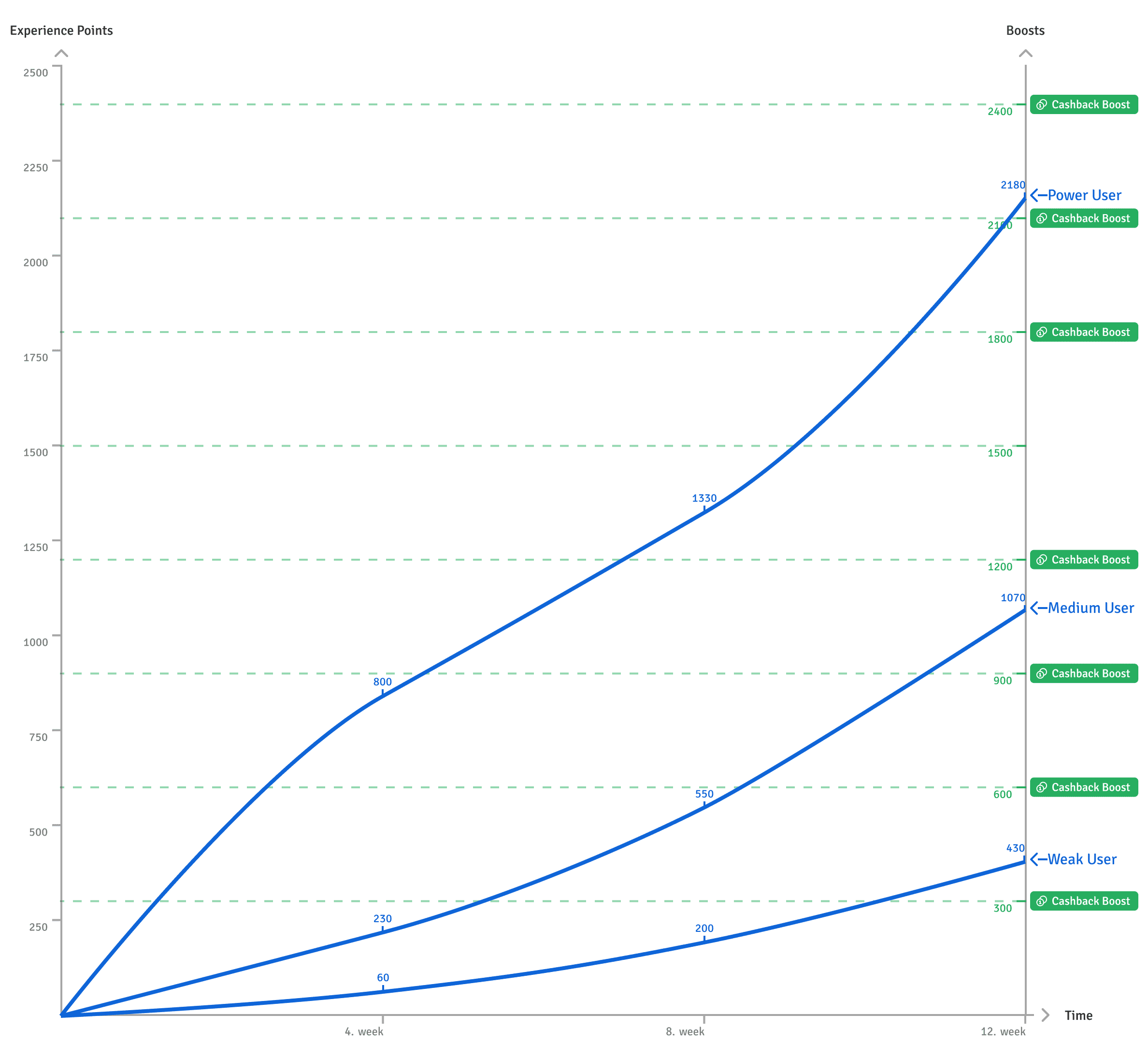
Modelled example earning patterns for different user profiles (light, typical, power users) to ensure loyalty mechanics felt meaningful without breaking business constraints.
Created early customer journeys to see where points would sit in the existing flow and where they would actually be felt.
Used a dormant internal promise (“save 250€ a year”) as a semantic pivot from “middleman” to “savings coach,” which led to Cashback-Mission.
Ran workshops with product, dev, operations, and CRM to stress-test feasibility, align expectations, and understand constraints around tracking, partner rules, and operations.
Ideated around five focus areas: personalisation, intrinsic motivation (mission), immediate reasons to engage (EP), clarity and reduced friction, and instant cashback options.
Early Loyalty Mechanics Diagram
Five Design Directions
To structure the solution, I translated the key insights into five focused design directions.
1. Personalised access
Surface what matters before users search.
Insight
Users repeatedly visit the same shops, indicating predictable behaviour.
Direction
Preference-based suggestions, behavioural recommendations, personalised entry points.
2. Intrinsic motivation
Turn cashback into a personal savings coach, the Cashback Mission.
Insight
Cashback is passive and lacks emotional engagement. A dormant promise (“save 250€/year”) suggests a stronger framing.
Direction
Cashback Mission with user-defined goals, progress tracking, and contextual nudges.
3. Immediate engagement
Bridge waiting time with continuous feedback.
Insight
Delayed confirmation creates long motivational gaps.
Direction
Introduced a unified point system (EP) for instant rewards, boosts, and exchanges.
4. Clarity & reduced friction
Make the interface instantly actionable.
Insight
Behaviour is narrow and task-driven:
homepage → search → shop → leave.
Direction
One-page dashboard, SmartSearch, actionable shop cards, unified value display.
5. Instant cashback
Introduce immediacy into a delayed system.
Insight
Some partner shops have reliable approval rates, low return rates, and low fraud risk.
Direction
Direct Cashback: optional instant payout with fee, reduced via points.
smartCashback Journey
Results
Loyalty needs an ecosystem
Loyalty points alone would become another silo. Loyalty needs an ecosystem: a mission, clear value surfaces, and continuous feedback loops that make staying engaged feel natural.
Behaviour enables personalisation
Users' shopping habits are highly predictable (same 1 - 3 shops), so personalisation can be a powerful and attainable. No need for advanced ML to start.
Missions create momentum
The Cashback-Mission concept (user-defined savings goal, progress tracking, contextual nudges) creates ownership and emotional momentum, turning cashback from a passive utility into a personal challenge.
Immediate rewards bridge gaps
A unified, instant reward currency (EP) can bridge the motivational gaps caused by long confirmation times, especially when tied to boosts, exchanges, and mission progress.
Direct cashback is high-risk
Direct Cashback (instant payout with a fee, reduced by EP) introduces choice and immediacy but needs to be treated as a high-sensitivity pilot because it assumes partner shops will honour cashback. A business risk if approvals fail after the user has already received the payout.
Design direction
The solution should not be “a points feature on top of cashback,” but a connected ecosystem: Experience Points, Boosts, Direct Cashback, Exchanges, personalised recommendations, SmartSearch, and Cashback-Mission, all anchored in one coherent structure.
Design
Translating the ecosystem into a concrete product
Purpose
Turn the conceptual ecosystem into an interface and system design that is simple enough for day‑to‑day use, but robust enough to grow with the organisation.
Approach
Defined “everything at a glance, ≤3 interactions per action” as a hard design constraint to fight complexity creep.
Designed a unified dashboard where users can see cashback status, EP, mission progress, recommendations, and tools in one place.
Broke the experience into feature blocks (EP, boosts, Direct Cashback, exchanges, personalisation, SmartSearch, mission) and designed each to reinforce the others.
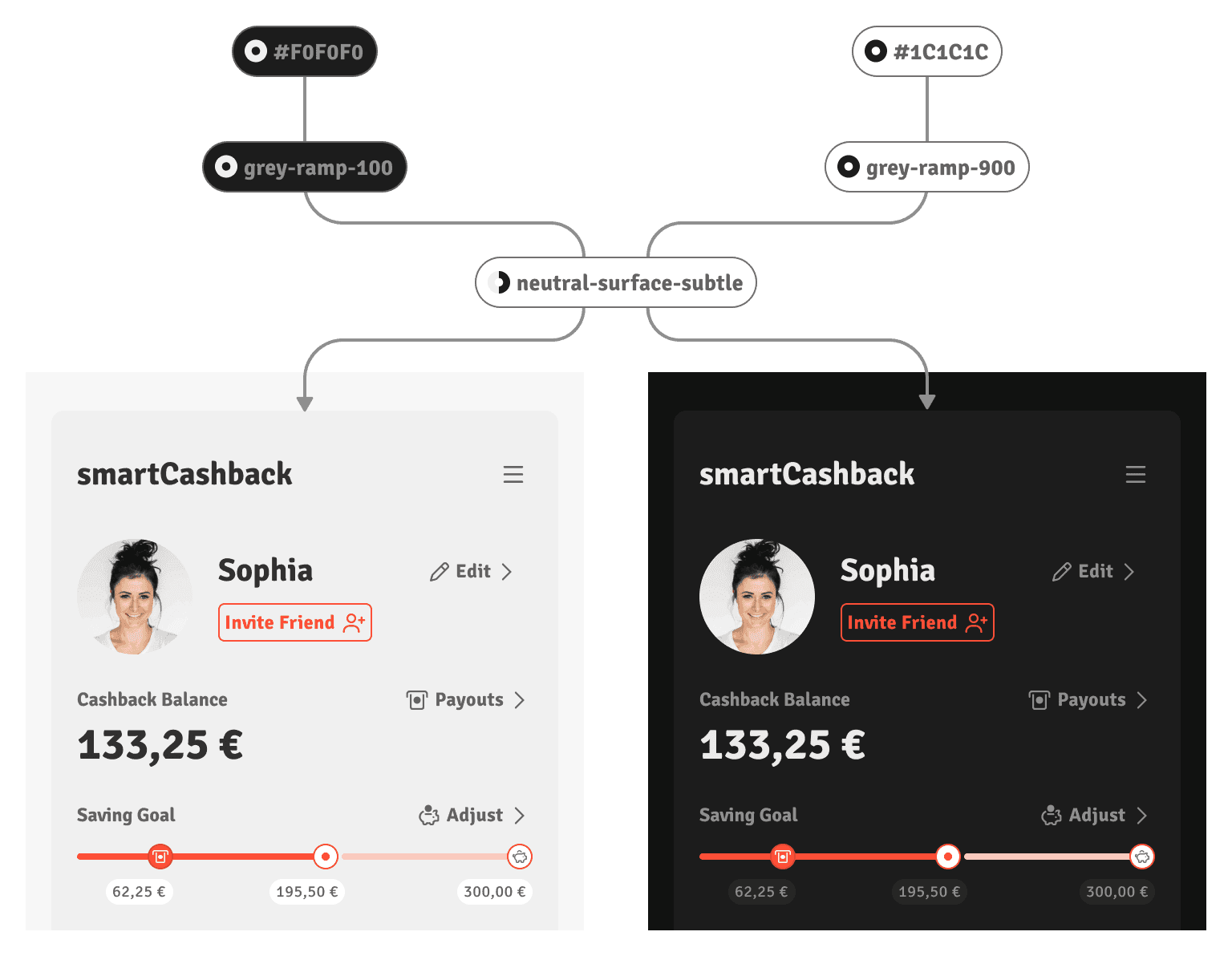
Developed a token-driven design system (colours, spacing, type, states, components) based on atomic design principles.
Documented flows, UI specs, interaction rules, and implementation suggestions to support development.
Core user flow
The design prioritises recognition over navigation: Recognize → Act → Confirm
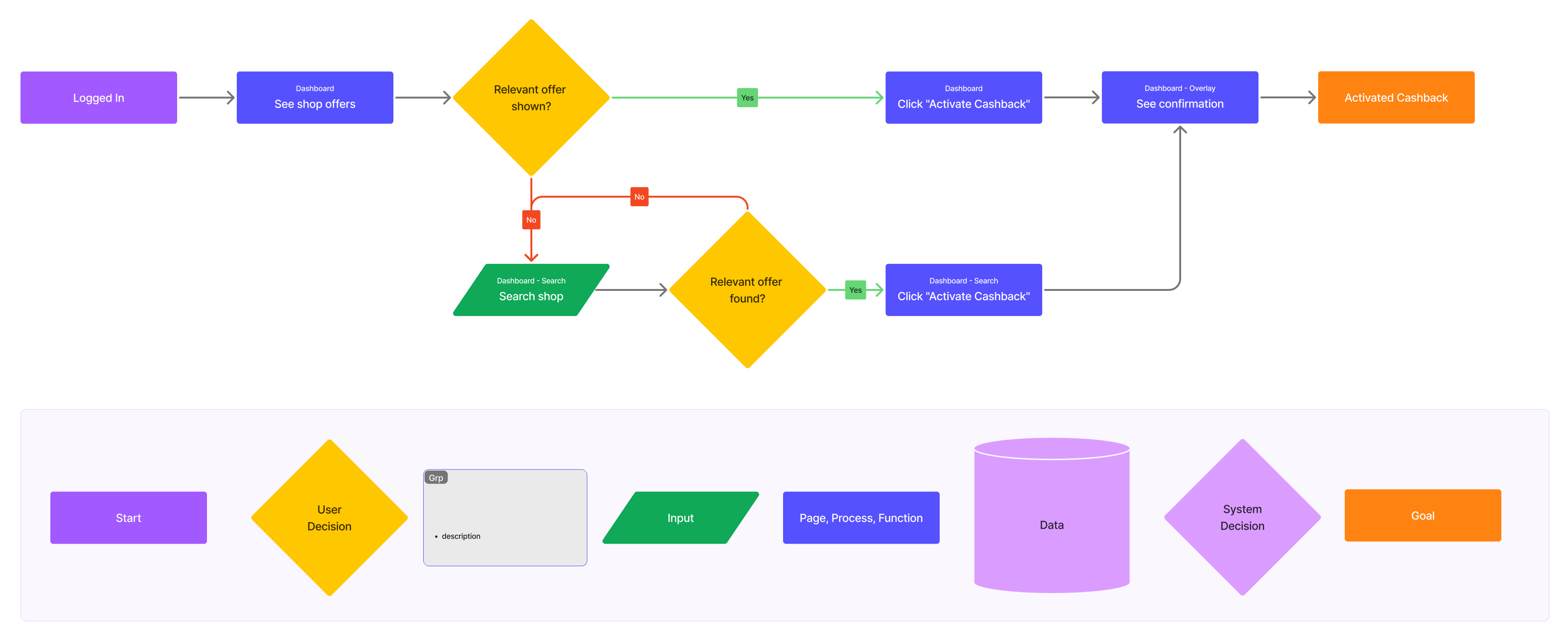
With simple, behavior-based personalisation (favourite shops, recent searches, activation history), even the most important core flow can be achieved with the given ≤3-interaction constraint.
From sketches to high fidelity
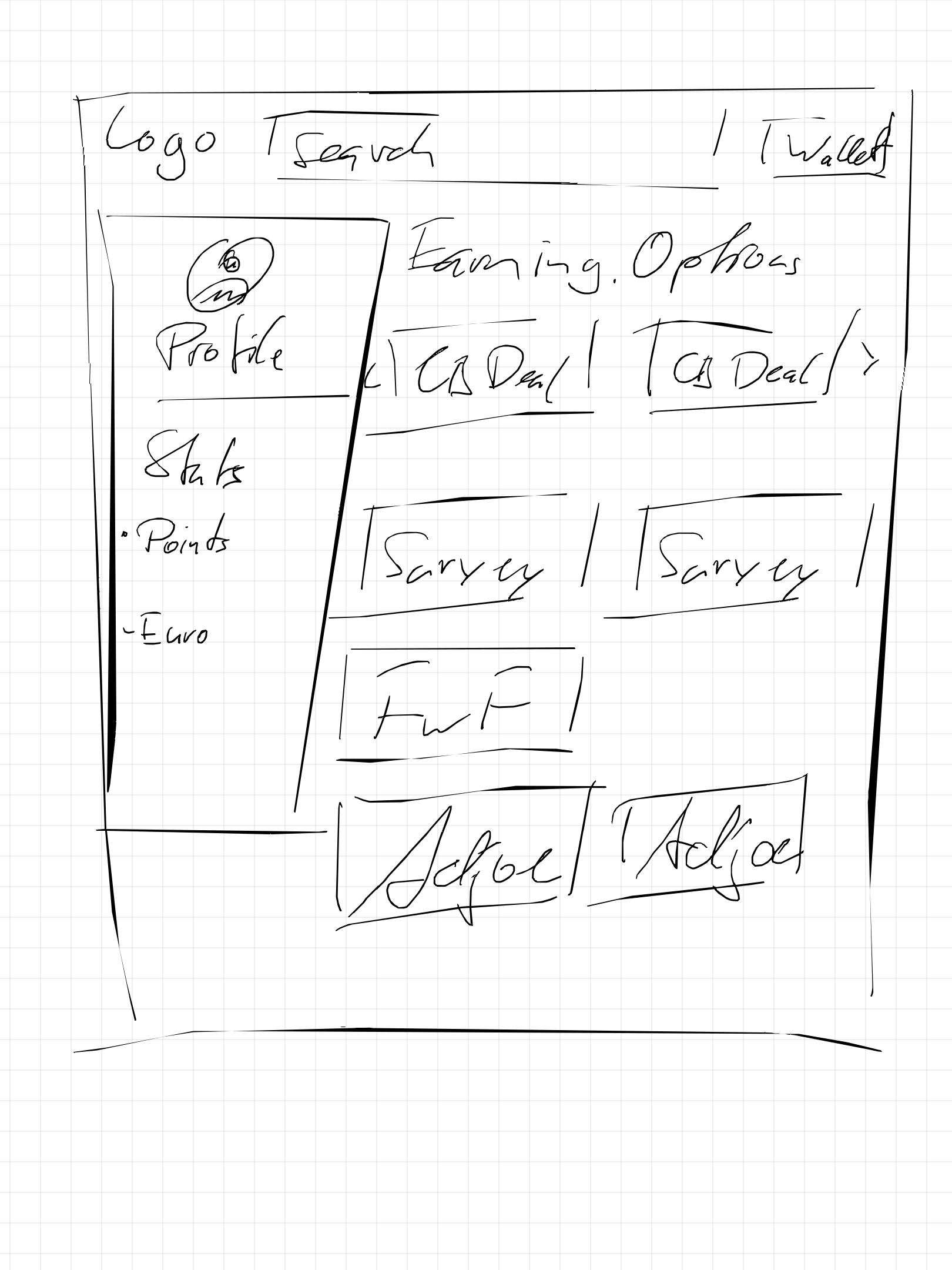
I began with low-fidelity sketches to validate the "everything at a glance" principle. I then moved through structured wireframes to define hierarchy, finishing with high-fidelity designs to resolve visual states. This dashboard proves the core flow and ≤3-interaction constraint remain intact across all fidelities.
Early structural sketch exploring how multiple value sources (cashback, offers, tools) can coexist in one unified dashboard without increasing cognitive load.
Wireframe defining hierarchy and modular layout, ensuring key value areas remain scannable and accessible within minimal interaction steps.
Mid-fidelity design introducing visual grouping and prioritisation, making personalised offers and core actions immediately recognisable.
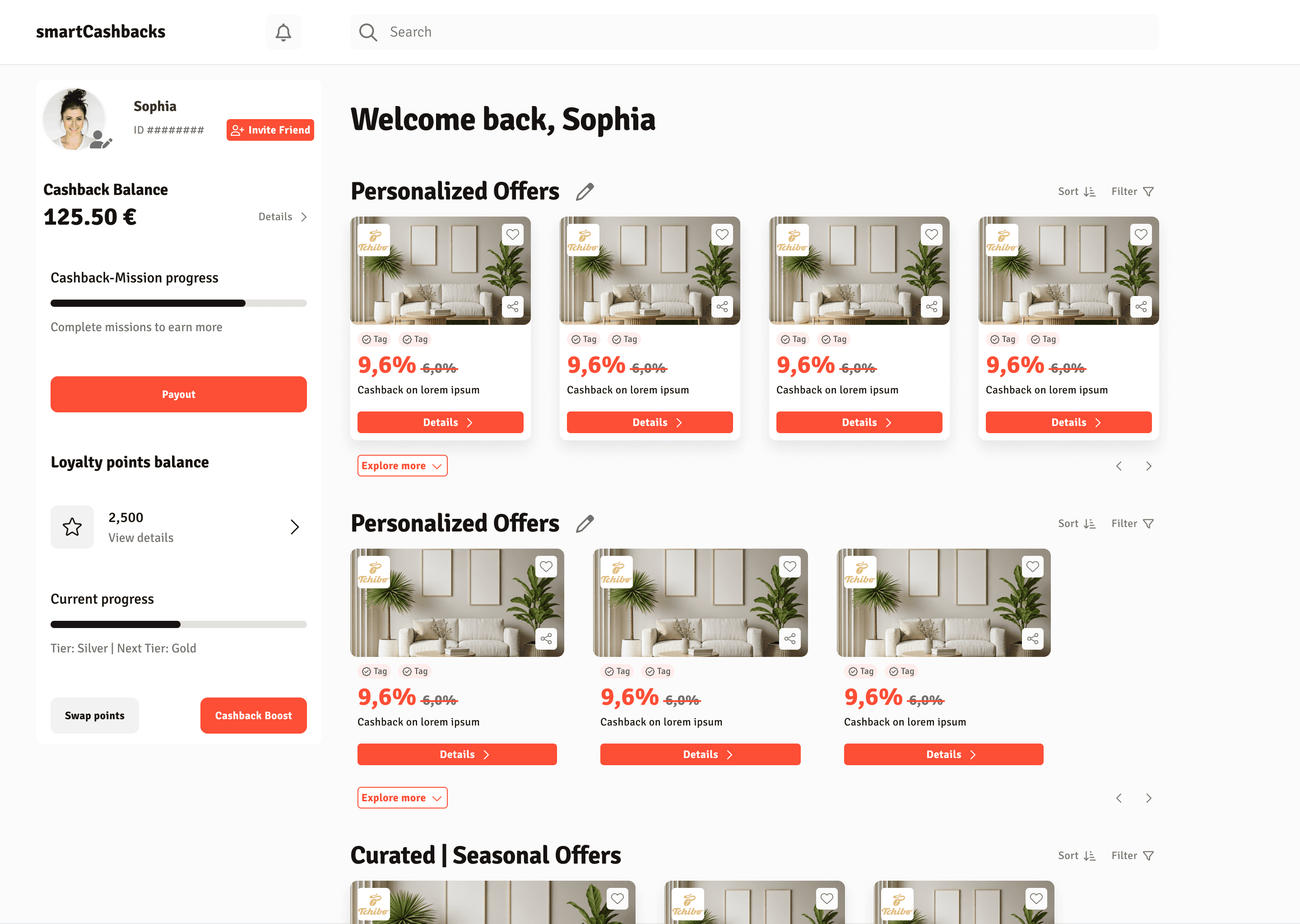
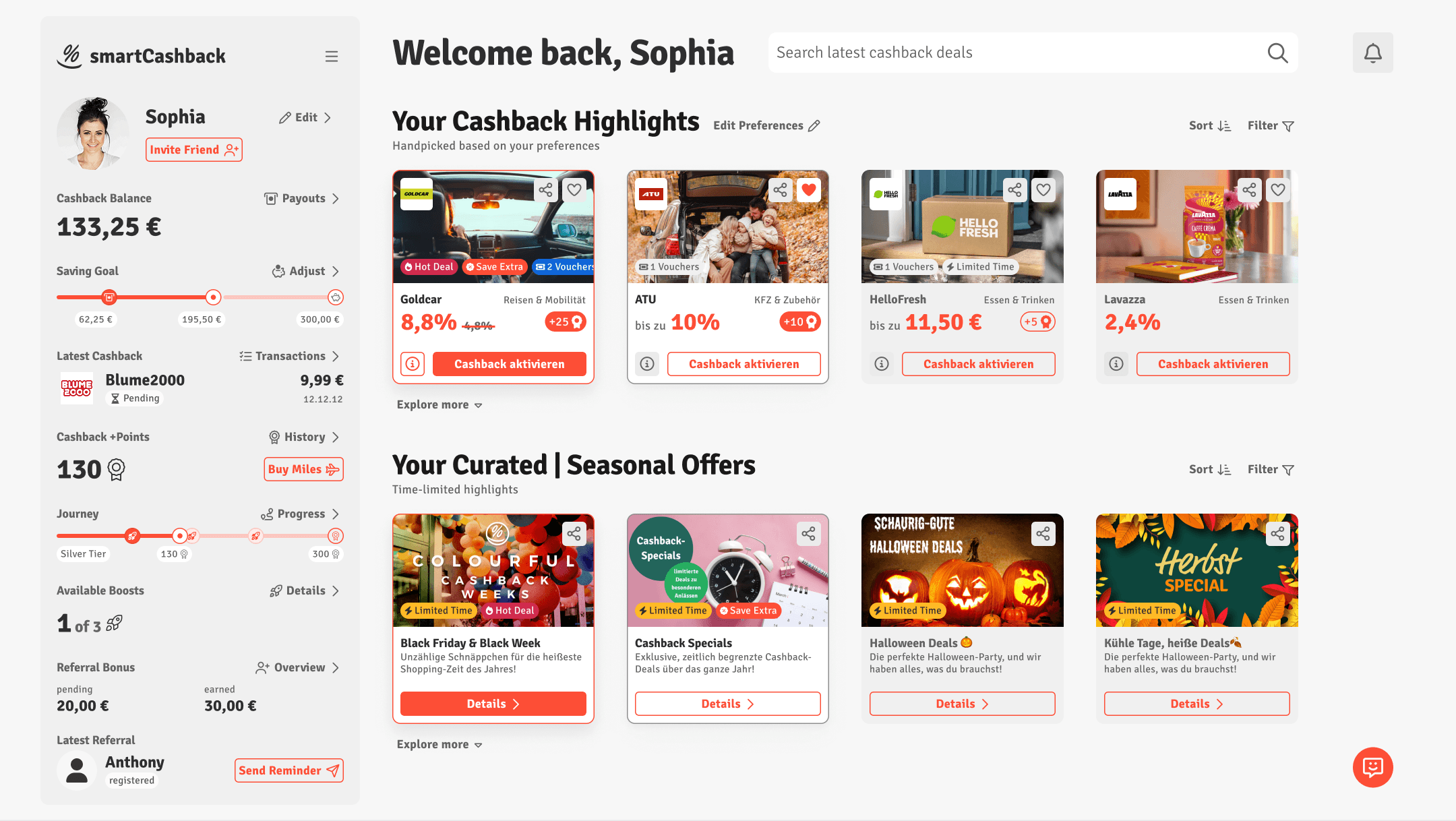
High-fidelity dashboard resolving visual clarity, interaction states, and component behaviour, while preserving the “everything at a glance” principle.
Token-driven design system
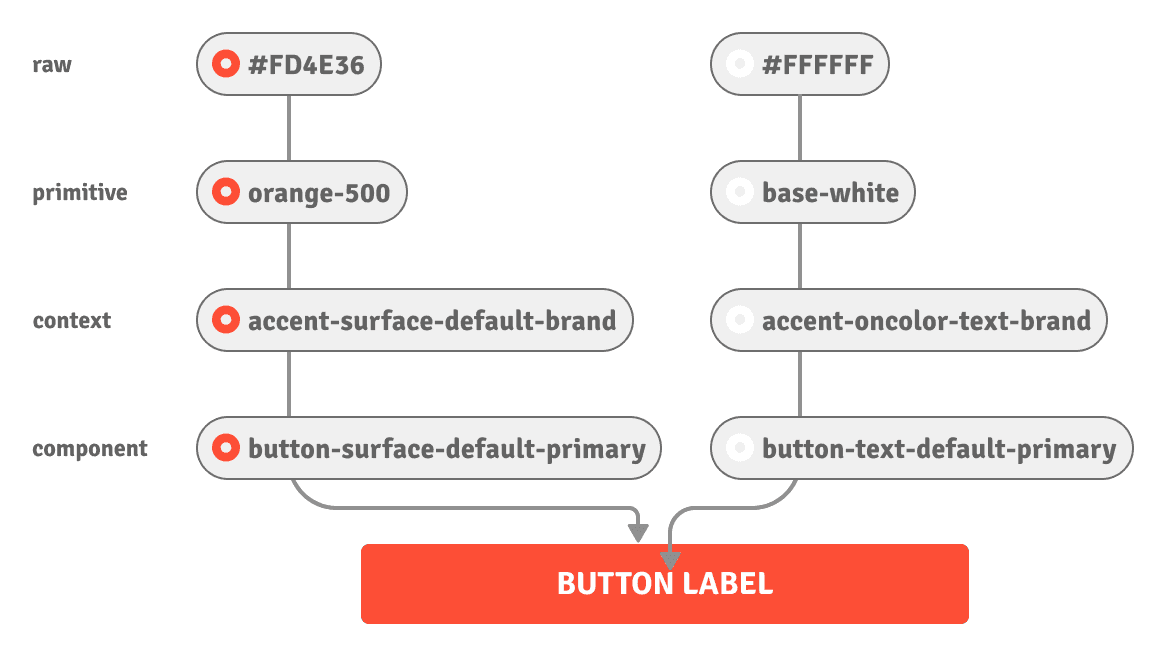
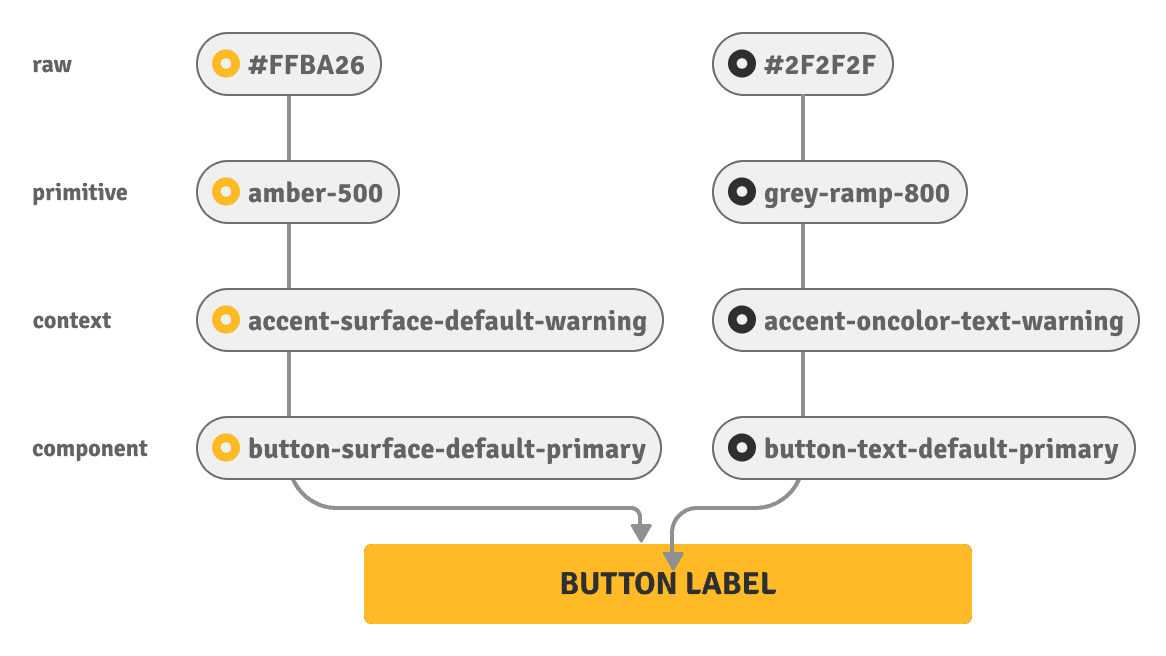
Key design decisions
Unified Dashboard for All Value
One place for tracked and available cashback, EP balance, mission progress, personalised shop recommendations, "For You" opportunities, and key tools eliminating the need to hunt across pages.
EP as Immediate Feedback
Earned instantly via activating cashback, referrals, gamified tasks, surveys. Spent on boosts, Direct Cashback fee reductions, and partner exchanges, creating continuous engagement instead of one-time transactions.
Mission as Savings Ownership
A simple slider and progress model that reframes savings as a personal mission with milestones and contextual nudges, turning an abstract concept into a tangible goal.
SmartSearch for Fast Discovery
Typo-tolerant, intent-aware search with personalised ranking, quick actions, and highlight tags to shorten the path to activation for users who know what they want.
Token System for Consistency
Establish atoms (tokens) → molecules → organisms, so that adding new surfaces or features doesn't break the visual and interaction language, future-proofing the system.
Handoff & roadmap
From concept to shippable product
Purpose
Ensure smartCashback does not die as a beautiful Figma file by giving the organisation a realistic, phased path from today’s product to the envisioned ecosystem.
Approach
Structured a roadmap that builds maturity in layers instead of shipping everything at once.
Mapped dependencies between dashboard, EP, personalisation, mission, cashback boosts, Direct Cashback, and partner integrations.
Differentiated low-risk foundational steps from high-sensitivity pilots (e.g., Direct Cashback) that require extra validation.
Prepared artefacts: roadmap overviews, strategy diagrams, feature block mapping, testing strategy, and prioritisation guidance for product and dev.
Roadmap elements
Phase 1
Foundations: Dashboard, internal reward currency basics, initial personalisation, Cashback-Mission MVP. Minimal backend disruption, maximum clarity.
Phase 2
Engagement Layer: Boosts, extended personalisation, improved SmartSearch, more earning opportunities. Deepen retention and test behaviour.
Phase 3
Loyalty Layer: Tiers, seasonal challenges, extended missions, richer exchanges. Shift to long-term loyalty ecosystem.
Phase 4
Scale & Optimise: Partner expansion, performance, ML-driven recommendations. Make the system robust and future-ready.
Phase 5
Direct Cashback (Pilot): Isolated, carefully monitored monetisation experiment dependent on merchant stability and operational safeguards.
Impact
The roadmap and system design together give the team a shared, realistic vision for “how to grow from cashback distributor to savings ecosystem” without pretending constraints don’t exist.
Learnings & Reflection
Designing ecosystems beats features
Thinking in relationships (EP ↔ boosts ↔ mission ↔ personalisation) creates a more resilient motivation model than any single mechanic could. Features compete, while ecosystems cooperate.
Clarity is a strategy, not a cosmetic layer
Simplifying value communication and making "everything at a glance" a hard constraint changed both the UI and how the team discussed and prioritised features. Clarity forced better decisions upstream.
Timing Is part of the experience
Balancing delayed cashback, instant EP, mid-term mission milestones, and long-term tiers leads to healthier engagement than chasing one metric. Motivation is temporal, not static.
Roadmap and design are inseparable
The concept only became credible internally once it was broken down into phases, dependencies, and risks. The roadmap is not a sequel to the design, but it's part of the design artefact.
Collaboration surfaces constraints
Conversations with dev, operations, CRM, and management turned potential blockers into design parameters. Constraints are features when you design with them, not around them.
Semantics matter
Reframing from "cashback and loyalty features" to "a savings ecosystem" aligned teams around a clearer, more meaningful definition of value. Language shapes thinking.
What’s next
Validate the core smartCashback foundations (dashboard, EP, mission, basic personalisation) through lightweight prototype testing, focusing on clarity and perceived control.
Collaborate with product and partners to define robust criteria for a Direct Cashback pilot, including risk thresholds and communication patterns, before exposing it to real users.
More works


Let’s talk.

Prefer a quick conversation? We can align on expectations, product context, and whether there is a good fit.
15 minutes